

How to Build an Employee Wellbeing Programme That Works

Most companies already have a wellbeing programme. Fewer have one that actually changes anything.
If you're an HR, People or L&D lead, you'll know the gap I mean. There's a wellbeing budget, a benefits platform, maybe a yoga session at the summer offsite. And underneath it, the same absenteeism, the same burnout cases, the same exit interviews mentioning stress. The activity is there. The outcome isn't.
"Wellbeing" is the term everyone uses, so it's the term we'll use here too. But it's worth being precise about what it actually means in a corporate context, because the word has picked up a lot of soft, optional-sounding baggage over the years: think mindfulness apps and fruit bowls, rather than anything a board would take seriously.
What we're actually talking about is human performance. Specifically, the physiology behind it: how stress, recovery, and nervous system regulation directly affect a person's ability to think clearly, make sound decisions, and sustain output under pressure. That isn't a soft skill. It's measurable, it's trainable, and it connects directly to the metrics HR, People and L&D teams are already accountable for: engagement, absenteeism, retention, performance.
So when this guide talks about wellbeing, read it as performance capacity. The programmes that get real traction with senior stakeholders, and real budget approval, are the ones built on that distinction from the start.
This guide is for anyone trying to close that gap: what a wellbeing programme needs to actually do, where mental health support and stress resilience fit, and how to know if it's working.
You’ve Built an Employee Wellbeing Programme But it Didn’t Move the Needle
Our experience having been into many businesses, is that the pattern is consistent across organisations, whatever their size or sector.
Organisations are investing heavily in strategy, technology, transformation and talent.
Yet many employees continue to report:
Mental fatigue
Decision overload
Reduced clarity
Poor recovery
Increased stress
Lower resilience
Burnout symptoms
The common response is to increase effort.
Work harder.
Work longer.
Push through.
But what if the problem isn't capability?
What if the problem is physiology?
Wellbeing problems never start as burnout. They start much earlier, as a slow drop in engagement, a drop in energy levels, chronic levels of stress, less sleep and higher levels of sick days, and by the time burnout is visible, it’s already shaping retention and performance in ways that are hard to reverse (VIWELL).
That’s the core problem with most programmes: they’re built to respond to burnout, not to catch what happens before it.
The usual mistakes:
Treating wellbeing as an event, not a system. A wellbeing week or a one-off talk centered around an “International Day of….”creates a spike in engagement and then nothing. There’s no mechanism to sustain it.
Physical health usually often gets the budget, mental and nervous system health get an afterthought.Although things are slowly changing, physical challenges are easy to run. Teaching people to actually regulate stress or manage mental health is much harder, yet way more useful.
No leadership visibility. If senior leaders don’t take part, employees read the programme as optional, or worse, as a box-ticking exercise.
Participation gets measured. Outcomes don’t. Knowing 200 people signed up for a session tells you nothing about whether they’re less stressed, sleeping better, or missing fewer days three months later.
A programme that works is designed the opposite way: as an ongoing system, built around what your people are actually dealing with, with leadership involved from the start and outcomes tracked from day one.
What an Effective Wellbeing Programme Actually Covers
There’s no single wellbeing initiative that fixes overwhelm and burnout. But the programmes that get real traction tend to cover the same ground.
1. Genuine mental health support
Not just a contact number to an employee assistance programme in the company handbook. Counselling access, mental health training for managers, and regular, structured space to talk about stress before it becomes a crisis.
2. Tools for stress resilience, not just stress awareness
Awareness campaigns tell people stress is bad for them. They already know. What moves the needle is giving people something to actually do with their nervous system when the pressure hits, in the middle of a difficult week, meeting or conversation, not just in a workshop.
This is where breathwork and nervous system regulation earn their place in a serious programme, not as a wellness extra, but as a functional & performance tool. Teaching someone how to shift out of a stress response immediately using their breath is a skill they carry into every high-pressure meeting, deadline, and difficult conversation going forward. It’s practical, evidence-based, and it works whether someone is dealing with a demanding sales quarter or a genuinely traumatic period at work.
3. Rest, recovery, and sleep as trained skills, not just permission
This is different from stress resilience tools. Point two is what someone does in the moment, under pressure. Recovery is what rebuilds the capacity to keep doing that, and without it, people aren't recovering between demands, just coping with an ever-deepening deficit.
Most organisations treat this as a policy question: are people allowed to take a lunch break, log off on time, use their annual leave. Necessary, but not sufficient. The more useful question is whether people actually know how to rest well when they get the chance, recognise the early signs of a recovery deficit before it turns into burnout, and build genuine downtime into a working day rather than just filling it with lower-intensity screen time. Sleep hygiene and nervous system reset are trainable skills here, not personality traits some people happen to have and others don't.
4. Leadership that visibly takes part
Programmes succeed or fail on whether leaders are seen using them. If your senior team skips the training but expects the rest of the business to attend, the message lands immediately and it probably isn’t the one you wanted.
5. A measurement framework from the outset
If you can’t measure it, you can’t defend the budget next year. More on this below.

There Is Also The Hidden Cost
Work-related stress, burnout, depression and anxiety have a significant impact on productivity and economic outcomes (World Health Organisation, 2019).
A member of staff may be responsible for making important decisions whilst operating in a state of chronic stress, impaired cognition, poor recovery and reduced emotional regulation.
Nobody sees it.
Nobody measures it.
Yet its impact can be felt throughout the organisation.
When staff operate under sustained physiological load, performance does not simply decline at an individual level. It ripples through teams, cultures and decision-making processes.
What “Measurable Outcomes” Actually Means
This is the part most wellbeing initiatives skip, and it’s the part your board or management actually cares about.
A useful starting framework, drawn from wider industry guidance on employee wellbeing, is to treat it as a continuous cycle rather than a single fix: assess what your people actually need, plan initiatives around that, implement them properly, measure the results, then improve based on what you learn (VIWELL).
In practice, the metrics worth tracking are:
Engagement scores - are people more invested, not just more aware?
Absenteeism - a genuine leading indicator of whether stress is being managed or building up
Participation rates - a starting point, not an endpoint
Retention - the metric that gets the board’s attention fastest
Qualitative feedback - what people actually say in exit interviews and pulse surveys, which numbers alone won’t catch
The organisations getting real ROI from wellbeing spend are the ones asking a different question. Not “does wellbeing matter?” (everyone agrees it does), but “what is this specific initiative doing to our engagement, retention, and resilience numbers, and can we prove it?”

Why This Matters Even More at Leadership Level
Everything above applies across a workforce. At leadership level, the stakes are sharper.
Executives making high-consequence decisions are subject to the same physiological pressures as everyone else, just with far less margin for error. One widely cited sleep study found that after two weeks of six hours’ sleep a night, cognitive performance was comparably impaired to being legally intoxicated, and most participants still believed they were functioning normally (Van Dongen et al., 2003). Separate research shows that sustained stress measurably degrades the prefrontal cortex, the part of the brain responsible for judgement, planning, and emotional regulation (Arnsten, 2009).
Put plainly: the people making your organisation’s highest-stakes calls may be operating with more impairment than anyone, including them, realises.
This is exactly the territory Vitae Vi is exploring in more depth in an upcoming White Paper on why leadership physiology deserves the same strategic attention as any other performance asset. Worth watching for if this is relevant to the exec team you’re building a programme around.
Vitae Vi in Practice: What This Looks Like With Real Teams
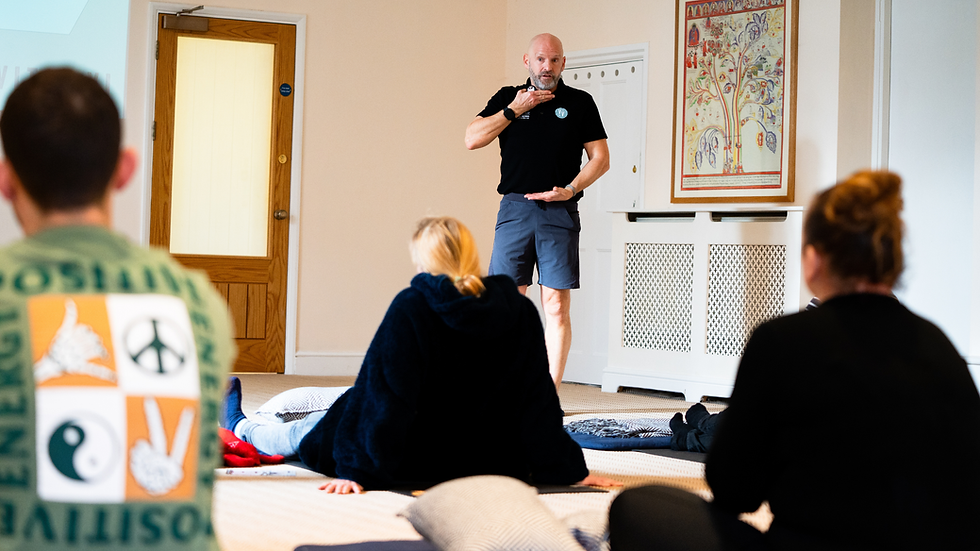
Vitae Vi’s corporate work sits inside exactly this gap, the space between “we ran a wellbeing session” and “our people actually have a tool they use.” The sessions are built on functional breathing, breathwork, rest & recovery and nervous system regulation, coached by facilitators with a genuine science-based and performance background & deep levels of training, not a generic wellness practitioner reading from a script.
That distinction matters to the people commissioning this work.
“As Senior Consultant of Learning & Development at Softcat plc, I’m always looking for training that not only develops our people professionally, but also equips them with tools to better manage the intense pressures of high-performance roles. Vitae Vi’s session, coached by both Dan & Karyn Hughes covering functional breathing, breathwork and cold immersion did exactly that, and more.”— Holly Wade, L&D Senior Consultant, Softcat plc
“We used Dan Hughes to deliver a Breathing Masterclass as part of our senior leadership development programme and what an impact he made! It was seriously insightful and pitched at just the right level. We loved the science and evidence behind the methods and these are already being used in terms of health and wellbeing strategies, managing stress, improving relationships and generally helping people to develop better sleep routines. He is a highly professional individual, has great interpersonal and coaching skills, and most of all, he delivers impact with genuine love and passion. If you are looking to improve health and generally help your people cope in today’s complex world, then look no further.”— Wayne Okell MBE, Training Director, Fair Ways
What both of these have in common is the same thread: the sessions weren’t received as a nice-to-have. They were received as a tool people could actually take back to their roles, whether that’s a high-performance sales environment or a senior leadership team carrying the weight of an entire organisation’s culture.
That’s the bar a wellbeing programme needs to clear. Not “did people enjoy it,” but “did it change what they’re able to do under pressure, and did that change stick.”

A Practical Checklist for HR, People and L&D Leaders
Before you commission or renew a wellbeing programme, it's worth checking it against this:
Is this built as an ongoing system, or a one-off event dressed up as a strategy?
Does it give people genuine mental health support, not just an EAP number in the handbook?
Does it give people a functional tool for stress and nervous system regulation, not just information about stress?
Does it treat rest, recovery, and sleep as trained skills, not just permission to log off?
Are senior leaders visibly participating, not just approving the budget?
Is there a measurement framework in place before launch, not bolted on afterwards?
Is the provider evidence-based, and can they show it, not just claim it?
If you're answering no to more than one or two of these, that's usually where the budget is being spent without the return to show for it.
Where to Start
A wellbeing programme that works isn’t bigger. It’s better designed, built around real tools your people will actually use when the pressure is on, backed by leadership, and measured properly from the start.
If you’re evaluating what a purpose-built, science-backed wellbeing programme could look like for your team, get in touch with Dan at Vitae Vi to talk through what a session or ongoing programme could look like for your organisation.


Comments